Front Load vs Top Load Washing Machine: Which Fits Your Home?
A counter, a narrow balcony or a machine you find awkward to unload can settle the front-load vs top-load question faster than a list of features.

Content Writer
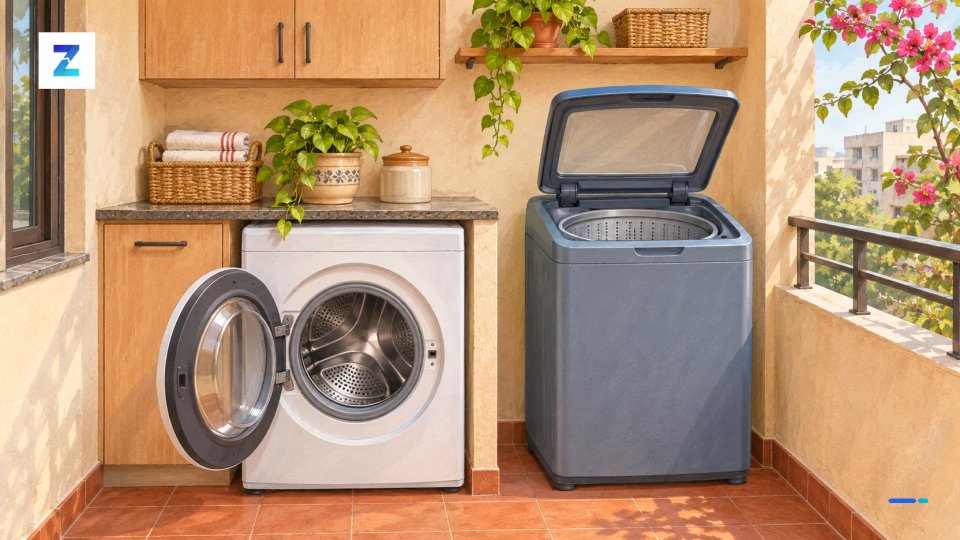
A front-load washing machine can work under a counter if the model fits and the door opens fully. A top-load machine can work where floor space in front is tight and there’s room to lift the lid. Before you choose, stand where you’ll do the washing and see how easily you can put clothes in and take them out. Check the exact model’s measurements before you pay.
Say you’ve found a 7 kg front-load washing machine at a price you like. You measure the gap on the balcony and the body fits. Then you realise the door will hit the railing when you open it. You’d have to stand sideways every time you pull out a wet bedsheet. You’ll be standing like that every time you do the washing.
That’s a good place to start when you’re choosing between front load and top load. Think about where the machine will sit, where you’ll put the basket, and who’ll be doing the washing. Once those three things make sense, it’s easier to compare individual machines.
Under a counter? Start with a front-load machine#
If you have a fixed counter above the machine, a front loader is usually the first one worth measuring. You load it from the front, so you can still reach the drum under the counter. Check whether the maker allows that model to go under a counter and how much space it needs around it. Use the full installed depth, including any room the hoses and connections need at the back.
Now check the front. If the door swings towards a wall or a cupboard, you may struggle to get the basket close or even pull out a blanket. Look at which way the door opens on the model you’re considering. Measure with a tape, then stand in the space with your basket where you’d normally put it. Can you reach the drum without moving the basket into the passage?
Narrow balcony? Try the same check with a top loader#
A top-load machine can make more sense when you can stand in front of it but there’s hardly any room for a door to swing out. Stand where you’ll load it and look up. Is there a shelf above it? Does the window open inwards? Could the raised lid hit the tap or the underside of the window?
Ask for the height of the machine with the lid fully open. The height on an ad may be the height with the lid shut. You’ll also want enough room to lift clothes out, especially something bulky like a wet bedsheet. If you have to take the washing basket off a shelf to open the lid every time, try a different position before settling on the machine.
Who’ll use it most days?#
If bending is tiring, try putting clothes into a top loader first. Then reach down to the bottom of the tub as if you’re taking out the last sock. A deep tub can be awkward for someone who can lift the lid easily but can’t reach that far down. Do the reverse with a front loader. See how it feels to crouch or bend far enough to get something at the back of the drum.
It helps if the person who usually does the laundry tries this when you go to see the machine. Try it while the machine is off and the drum is empty. You’ll know whether you can reach all the way in. If you’re thinking of raising a front loader, check whether that model supports a suitable pedestal and whether it still fits the space at the new height.
Compare the way you wash, then compare the models#
Once both types fit, think about what goes in during a normal week. A family that washes small loads most days will use the machine differently from someone who washes towels and bedsheets together on Sundays. Look at the cycles you’ll use and check the manual for bulky loads. Two machines marked 7 kg can suit the same amount of ordinary laundry while feeling different to load or offering different cycles.
If water or electricity costs are the deciding factor, compare the figures for the exact models under comparable test conditions, where the maker supplies them. Check the label and model details rather than going by the loading style, especially if one machine is older. If the water supply in your building comes at fixed hours or the tap has weak flow, check the model’s inlet requirements before you decide.
If you’re looking at a semi-automatic machine with separate wash and spin tubs, think about whether you’re happy moving wet clothes from one tub to the other. It can also open from the top, so ask which type it is when an ad just says “top load.”
Put two machines side by side before you pay#
Put the measurements next to the ads you’ve saved. For example, say you have 48 cm between the front of the machine and the railing. The seller measures their front loader with the door fully open and it needs 55 cm in that spot. Cross that model off. For the top loader, say there’s a shelf 132 cm from the floor and the open lid reaches 124 cm. Check the maker’s clearance first, then see whether you can lift a sheet out comfortably under the shelf. These are example measurements. Ask the seller to measure the actual machine you’re considering.
Pick the type first, then compare washing-machine ads on Zutilo. Ask for the exact model number and a photo with the door or lid fully open. Make sure the machine can pass through your doorway, then check the used machine’s condition and ask to see it working before you pay. If you’re replacing a machine you still have at home, see what to include when you list it.
Explore on Zutilo
Browse local listings, compare the details and contact a seller when you find something useful.
Browse Washing MachinesBrowse related listings
Quick shortcutsFrequently Asked Questions
3 questionsCheck whether the maker allows that model to sit under a counter. Compare the height and installed depth with your space, then check the room needed to open the door and reach the connections.
You load it from above, which may be easier if bending is uncomfortable. Try reaching the bottom of the tub too. Its depth and your height make a difference when you take out the last few clothes.
Top load describes where you put the clothes in. A fully automatic top loader can wash and spin in the same tub. With a twin-tub semi-automatic machine, you move the wet clothes to the spin tub yourself.